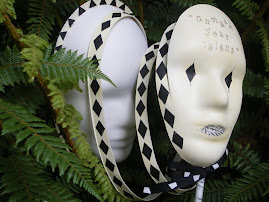
"Given that we can live only a small part of what there is in us - what happens with the rest?"

Quote by Pascal Mercier

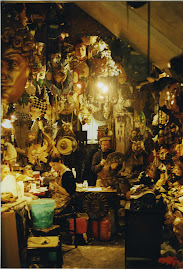
My mask making began with a visit to the Alice Atelier, Florence Italy, where I met Professor Agostino Dessi and daughter Alice and learned how to make a mask the traditional Italian way. “These are story containers” Agostino explains, “Stories are delicate, it’s best to store them in places that suit them. The stories a person can give to the world are precious”. Visit the Alice Atelier at http://www.alicemasks.com/

“Masks are made to liberate people’s hearts and minds” Agostino Dessi.

Saturday, August 22, 2009

Tuesday, June 9, 2009

Webbed Vision


This mask composition was inspired by a strong dream in which a spider appeared, weaver of fate and destiny. The mask is constructed from spider-eye beads, 3x on-the-round jigsaw pieces, and antique French silk. Charlyne says: "Love your latest work, delicate and ethereal. I admire how your work is always evolving, and thought provoking." Thanks darling Char...

Sunday, February 22, 2009

Visual Taste Composition

This is a wee 'taste' of where my mask making is going. This mask is made out of meat, yes, rosy-pink proscuitto! I found the proscuitto to be an excellent moulding material. Sadly, i have had to take the "meat mask" out of the spare room where it was drying because it was getting a bit whiffy. Next i tried making a "sushi mask" from wet seaweed, which looked rather nice to begin with but as it dried it started to buckle and peel off the mould, so that one is a work-in-progress. You might be wondering what is the point of making masks out of edible kitchen materials and foodstuffs...it's the duo-challenge of using unusual materials artistically and finding beauty where you least expect it! Why make a sandwich when you can make a piece of mask art?

Friday, July 25, 2008

TinkerBelle

Since a young 14-year-old member of our family left his bag of skin and bones behind...i have been making lots of winged mask characters. I have made five butterfly mask compositions (one more to go), and this...the first in a TinkerBelle Series.

Sunday, June 22, 2008

Dunedin Midwinter Carnival '08


It is Winter Solstice here in Dunedin and time to celebrate the shortest day/longest night with our annual Midwinter Carnival where hundreds of lantern-bearers, young and old, take to the streets with hand crafted, candlelit paper lanterns. This year's theme was New Zealand birds so huge papery tuis, albatross, fantail, owls featured in the pagaent. Seven masked dancers looked enchanting with their whitened hair, faces and "winter sprite masks". An extravagant fireworks show sent sparks raining down on the rapt crowd and the paper firebird lanterns. Conditions couldn't have been better with the weather mild and the night crisp, clear and windless, quite a contrast to last year when the event had to be cancelled due to a wild snowstorm. Note: The figure in the white mask holding the Owl Lantern is moi!!

Wednesday, May 21, 2008

Ochre Eyes: Pamela Croft Response Exhibition Australia


Typically the Aboriginal artist adopts a viewpoint which elevates the mind’s eye to a broader panoramic view - a bird’s eye view approach called “spirit perspective”. Such an aerial view involves a marvelous look; a look that does not take but receives in the mansion of the mind…the only sustainable viewpoint.

In response to Dr. Pamela Croft’s textured visual narrative workshop at TAFTA, Brisbane, June 2007, this artwork features two masks. The two masks are about differing perspectives or viewpoints (both ways of seeing). The “ochre eyes” mask represents the indigenous “spirit perspective”, while the white “exploded”* mask represents the disintegrating power of the white (Western) gaze.

*The white mask ‘exploded’ during its hot pressed paper moulding process and so, rather than discard it because of its imperfection, I used it as it was. The words "Finally, like broken eggshell, the face of white mischief cracks...and falls away" were later added around the rim.

After a lifetime of looking at things solely through a white Western perspective your eyes get lost. Making this textured visual narrative was an eye-quest to find my way home. This 12 x 12 Composition in Mask is created from two Multimasks (premoulded recycled paper base masks), ethically-sourced Australian ochre, shoe polish, acrylic paints, recycled sari silk, stretched canvas frame, ripped brochure “Broken Links: the Stolen Generations in Queensland” decoupage.

Sunday, February 3, 2008

Rose Monday

Rose Monday 4th February '08 (which precedes Shrove Tuesday) is marked by huge masked parades in the cities of Cologne, Dusseldorf and Mainz when these carnival centres are crowded with visitors. Musicians in costume, dance troupes, huge floats manifesting political satire, jesters, false noses, confetti, fancy hats, dress-ups and rose-throwing mean it must be Rose Monday in Germany.

Rose Monday festivities began in the early 19th century and have become an annual fixture. Rose Monday is the highlight of the carnival period - sometimes called "the fifth season" - which began its preparations on the 11th November '07 right up until Ash Wednesday (6th February '08) on which day Lent begins and lasts until Easter.

Sunday, January 27, 2008

Masking for Clarity

To see Masking for Clarity: working with Multimask, found objects and light - view http://www.photoblog.com/showoffs/2008/01/27/

This collection of my latest "signature compositions" emphasizes the portrayal of authentic (rings true) visual narrative through the mediums of mask and digital photography.

By "sitting in the masks" as i work, i find creative ways of exploring the conventions of masks and ways of challenging attitudes and ideas about them.

Monday, January 14, 2008

The best art comes from inside out


These are mask making students in Chicago. This picture was sent by Jeff Semmerling, a professional artist and art educator who is currently involved in the 2008 season of the New Orleans Mardi Gras. Jeff first arrived in New Orleans in 1981 and after becoming immersed in the carnival experience was spellbound by the ability of masks to allow people to express their eagerness to live.

Here is a snippet from an article about this extraordinary mask maker written by Kaity Nicastri:
"On the corner of Montrose and Damen, there is an understated storefront with the white sign above it proclaiming it "The Inside Out Art Studio: Serious Fun for Artists of All Ages". Inside this shop is a treasure trove of hand made masks and puppets created by an artist named Jeff Semmerling and his partner Sonja Schaefer. With training from the best mask-makers in New Orleans, Jeff has brought his passion for the masking experience back to his native Chicago. "When wearing a mask, it's not you; but yet it is you! That's the magic!" says Semmerling." http://www.insideoutarts.us/

Saturday, January 12, 2008

"Senor Taco Salsa" (about Mardi Gras)


Mardi Gras is celebrated around the world but no one, it is said, does it like New Orleans. Twelfth Night (after Christmas), or January 6th, is when the New Orleans Mardi Gras month-long season begins - and continues until the midnight of Fat Tuesday, 5th February. Fat Tuesday is always the day before Ash Wednesday, and the day after the lesser known Rose Monday.
Mardi Gras parades have been staged in New Orleans since the 1837 (as evidenced by a first newspaper account describing masqueraders "in such grotesque and outlandish habiliments") and in 1857 the modern incarnation of Mardi Gras took shape with the founding of the first Krewe, a kind of official parading organisation. Today there are hundreds of Mardi Gras clubs that continue to conduct elaborate, colourful, outrageous political cabaret throughout the streets of New Orleans.
Katrina Gras - In 2005, after the devastation of Hurricane Katrina, the city opted to uphold its Mardi Gras tradition. Some people objected, but for others it was deemed a "therapeutic antidote" for what was perceived as a woefully inadequate government response to the disaster. Participants reportedly wore blue biohazard suits and blue tarps, and went about portraying blind people while wearing T-shirts that read "Levee Inspector".
For movie and more info check out http://www.mardigrasunmasked.com/

('Senior Taco Salsa' is a scarecrow found at the Lawrence Arts Festival, January '08, New Zealand.)

Thursday, November 22, 2007

Face Shell

Even now, after all these years of making masks, sometimes I am still daunted by the prospect of making that first mark on the pristine white surface of my Multimask tabla rasa (blank slate). What if i mess it up?

Performing artist Hilary Halba of the University of Otago Theatre Studies has this to say:

"...while one's aspirations are still in one's imagination, they are perfect and anything's possible, but the minute you actually make a start on doing anything is the minute error begins, or the minute disappointment happens or the minute that imperfection seeps in".

Dealing with the Con-troll lurking under the bridge:
A good way to deal with those feelings - the terror, anxiety, hopes, dreams - that is the crux of going on a soul-searching quest or just making something better than average, is to treat the Multimask in a way that is beyond conscious control. This "little old Chinese lady" was dampened then oven-baked before coming out all randomly wrinkled. Did you know that the Chinese word for mask 'mian hok' means "face shell". I like the above 'face shell' so much i cannot bear to do anything further to it! It's perfect as it is...

Wednesday, November 21, 2007

A Refined Escape


A woman once told me that dressing up [in mask & costume] was about creating a world safe as a child's bedroom should be - where she "cannot be reached". By dressing up she was saying: the imagination, the body, the world is not hostile. Did you know that Picasso thought along similar lines...that his paintings were a refined escape from a hostile world. Interesting thought!

Thursday, November 15, 2007

"Ippinquill" - a new carnival arts character

To celebrate the November '07 launch of our new MASKWORX website http://www.maskworx.co.nz/ i have devised Ippinquill - a 'carnival arts' character - using layers of clever cutouts from about 15 Multimasks, a strong pair of scissors, a curved tip pair of scissors, a pencil and two bead buttons.

The point of this playful exercise is to transform the Multimask classic face shape into a carnivalesque (happily exaggerated) face scape with a new agenda. Our new carnival arts character is facing an identity crisis: Ippinquill no longer recalls where it comes from? Ippinquill doesn't appear to know where it is going? And...Ippinquill doesn't want (to know) anything?

To the visual storyteller, this presents a problemo dramatico: What sort of portrayal is it when the usual identity cues are missing? But perhaps more importantly...what sort of audience plays along with a central character who is unrecognisable? I am grappling with these ideas...

Sunday, October 14, 2007

Halloween - a night of enchantment


While spring has arrived here Downunder, the northern hemisphere is getting ready for Halloween.

One of the oldest celebrations in the world, Halloween was originally an agrarian folk festival marking the end of harvest-time, hence the signature colours orange and black; orange holiday foods such as pumpkin pie, apple cider, caramel apples with roasted pumpkin seeds, and the colour black symbolising impending winter and the inevitable cycle of dying.

Many people think Halloween is an American custom (and doubt its relevance beyond the USA), but the original Halloween began in Ireland. In the 1840’s Halloween was exported to America as Irish immigrants rushed to escape their country’s potato famine.

Dating back over two thousand years in Celtic Ireland, the summer season officially ended on October 31. Then the holiday was called Samhain (sow-en) and grew out of the rituals of Celts celebrating their New Year.

Today Halloween has become a confusing mixture of practices. For contemporary Halloween fun check out these links
http://www.halloween-online.com/ and http://www.365halloween.com/

Monday, October 8, 2007

Every face tells a story


Spring has arrived in New Zealand, bringing with it a new ‘career path’ for masks. The traditional disguise ‘n display masquerade mask is undergoing a make-over as it moves away from the fringes [of the art establishment]…

Right now new festivals devoted specifically to masks are bursting onto the global scene. Check out Ireland’s inaugural annual Trim Festival of Masks, described as “a six day boutique festival for a discerning audience”, and taking place 24th – 29th October.
http://www.festivalofmasks.ie/

Check out next the West Midlands, UK inaugural International Festival of Masks, described as “providing an unmissable opportunity to experience world class international performances, explore the history, magic, emotion, excitement, art and humor behind the mask”, and taking place 19th – 27th October.
http://www.internationalmaskfestival.com/

MasQue 2007, another new international mask theatre festival was held last month (September) in Finland. Check out Theatre Metamorfoosi, described as doing “research related to masks, preparing masks and giving education in mask theatre”.
http://www.metamorfoosi.com/english/

Seeing such strong elements of education (such as making workshops and academic papers) underpinning these three inaugural mask festivals is encouraging (MASKWORX has sent sample packs of the Multimask System and we eagerly await their feedback). There is something liberating about making your own stuff. Making stuff switches on new ways of seeing and thinking which ultimately has wider applications. Today, the only thing hiding behind the contemporary mask is... a story

“You must want [to tell] it with an exuberance that erupts through the skin and joins the energy that created the world”
Sheila Graham

To make this Apple Blossom Mask you will need:
One Ultra Multimask, scissors and sandpaper
Fas White Gesso Primer (fast drying sealer)
White gloss spraypaint
Good quality paintbrush (eg. Francheville Taklon)
Braiding
Hot glue gun
Wedding lace for eye detail
3M Spray adhesive
Nail polish or glitter (for lippy detail)
Ribbon ties and dowelling stick

Cutting:
Cut out an oval or heart-shaped face. It is best to start cutting a few centimeters outside the chosen embossed line with a strong pair of scissors to remove excess, then trim neatly as close to the embossed line as possible.
Carefully ‘open’ the eyes following safety guidelines.
Sandpaper any rough edges.

Painting:
Simply paint your base mask with a coat of white gesso (when using spray paint it is essential to seal the base first due to the absorbency of the Multimask). Dry thoroughly (will only take 5 minutes on a heater).
Take the sealed base mask outside and spray with white gloss. To achieve a really professional-looking surface, up to five or six light coats may be necessary.

Embellishment:
First attach the hand-held dowelling stick to the back of the painted base mask. I covered my stick in coloured scrap paper to add dimension to my ‘apple blossom’ visual story.
Next glue braid around the edges of the mask, finishing at the bottom where the ‘chin’ meets the stick. Affix ends neatly and tie ribbons around it.
Trim the wedding lace and stick on with spray adhesive to accentuate the eyes.
Rub a small amount of complementary colour on the cheekbones in a circular motion (optional).
Use a pencil to draw a heart-shaped outline for the lippy detail.
Fill in the outline with nail polish (using the polish brush is fine) or glue ‘n glitter.
Enjoy your sweet little Mask of Spring…the one you made yourself!!

Sunday, October 7, 2007

For Elisabeth (aka Madama Butterfly)


To me, Elisabeth Kubler Ross is Madama Butterfly...and today is an auspicious day. October 7, 2007 is the day Elisabeth Kubler Ross, scientist, doctor, educator, mother, is inducted (posthumously, for she passed away on August 24, 2004) in a special ceremony into the National Women’s Hall of Fame in the United States.

Dr. Elisabeth Kubler Ross is best known as the person who revolutionized grief and bereavement attitudes toward dying patients and their families. She was responsible for bringing the concept of “dying with dignity” into mainstream medicine, and when she toured New Zealand (1985) I spent one week with this tiny great lady, a chain smoker who puffed outside on the cold concrete steps flicking ash all over her open-toed roman sandals.

In Elisabeth’s presence (we were allowed to call her Elisabeth, but never “Liz”) I woke up to masks. First came a silly ‘mask’ drawing, then a collage pasted with paper mask cutouts, next I really wanted to make a whole mask from scratch. How hard could it be?

How hard can it be? Twenty years later I am still obsessing about it!

Last week, on a night with a most beautiful and numinous full moon, and more than twenty years since I saw her last, EKR appeared to me in a dream, her eyes twinkling. Using the telepathic ‘voice’ peculiar to dream sequences I communicated with her that she was looking in fine spirit (considering she was dead!!)

“Was it all worth it?” I wondered out loud, remembering how EKR had endured rotten tomatoes being thrown her way simply because she had been daring enough to tell us modern disenchanted people that we were spiritual beings whether we liked it or not (not to mention her “unconditional love” for AIDS babies)…

She assured me IT WAS.

Indeed, for today is the day EKR takes her place amongst 217 other great women in the NWHOF. More power to Her!
http://www.greatwomen.org/

Check out http://www.elisabethkublerross.com/pages/store.html. Here you will find tiny paper butterflies* impregnated with flower seeds for planting in the garden. How cool is that?
*Elisabeth’s symbol of hope, renewal and new life.

Saturday, October 6, 2007

Authentic storytelling wears no costume

Recently I went to hear an African storyteller at our local library. From the moment she entered the room her strong presence was palpable. She seemed scarily powerful, even when the microphone stopped working and she had to rely on her own voice. She used no props other than a stick which she banged like a percussion instrument on a wooden floorboard. She wore no costume but when she changed character her face instantly became a 'mask' and she was... an old man, insect, wind, bird, anything, anyone... You could hear a pin drop during the telling of these tales resonant of African slavery and moral tales originally told to keep children safe.

This session was in stark contrast to one I attended the evening before. At our local university I attended an inaugural professorial lecture about 'higher education', a shambollic 'storytelling' event where the speaker wore full academic costume, had full IT support (the microphone, etc worked!!) with a banquet waiting upstairs (could have fed the whole of Ethiopia), but who lost the audiences attention with his pompous whitterings.

The two speakers couldn't have been more different! Authenticity requires no costume...

While studying African Primal Religions I came across a paper on Makishi, which is a celebration of masquerade or mask-wearing among the Mbunda people of Zambia (makishi being the plural form of likishi, the mask itself). In this region of Africa it was observed that the men wore masks but when women performed the makishi dance they did not. Early anthropologists had made the assumption that masks were restricted to menfolk because they were "too powerful" for womenfolk to handle.

Disputing this male power argument the female author claimed that early anthropologists had asked the wrong question; the issue at stake was not who owned or performed in the masks, but who in the community knew the proper response (to the masks). And by responding appropriately to the cast of makishi characters the women, she argued, acted out a kind of diplomacy in motion, the ‘glue’ necessary for community cohesion. What really informs your status - as medicine man, shaman or modern storytelling equivalent – is not what you wear... but the way others react.

Two words help define a “Maskerpiece”: depth and power. The more critical thinking that goes into the design and construction (depth), the more likely there will be an evocative or provocative aesthetic response (power).

To make this Makishi Mask you will need:
One Ultra Multimask, scissors and sandpaper
Painting and sealing:
Gesso, black
Weaving:
String woven from coconut fibre (or equivalent), apply to rim and sides of mask
Hot glue gun, stick weaving on before polishing or else the fibre won’t stick well
Polishing:
Kiwi Shoe Polish, dark tan + soft rag to apply + brush
Adornment:
Textile strips
Two handmade beads (available from bead store)
Mark-making:
Ash (from firebox), wipe on with fingers, sometimes the simplest of details is the most stunning.
Finishing touches:
Key (a 'Trickster' symbol)
Small ‘bee’ beadling (symbolising Queen Bee, or Africa as Mother of Masks)
Sometimes when you are making a composition, you don’t know why some symbols (like keys and bees) work well together, you just know it fits so if it makes your eyes happy, run with it.

Wednesday, October 3, 2007

The Road to Mecca (a play)


It had been three years since I last set foot inside Dunedin's Globe Theatre, and although wary I judged it safe enough to return. The play I wanted to see was about the life and works of Helen Martins of New Bethesda, who strived within a crushingly conservative community to bring light and colour into her life by embellishing her environment with reflective mirror patterns and concrete sculptures of the oddest, most eccentric kind. Her home – the Owl House – is now a famous tourist attraction in South Africa, a ‘Mecca’ of sorts with lots of mirrors.
http://www.owlhouse.co.za/

I remembered those cramped red seats and close, interiorized setting. The play was intense, brilliantly acted, a credit to cast and director. But unexpectedly at the play’s ending, that moment when the cast usually takes their bows, we the audience, were asked “do please stand for a minute’s silence” (we weren’t sure if this odd request was part of the play, or not?). Turns out the photographer responsible for taking promotional shots a few days earlier had died unexpectedly. That really creeped me out!

Because three years earlier, my crew and I were photographing masks for publicity purposes in the old Globe theatre just days before death struck…

...We found a rich red coat amongst the Globe’s comprehensive costume collection and had dressed the model in coat and red “Death” (no-one but me knew the mask she wore was named “Death”). Inside the Globe was pretty gloomy. Our photographer’s assistant, a talented young photography student from Japan, was running late so my job was to reflect light onto the model using a large mirror found on site.

Just as I was hefting the mirror into a good position the student photographer duly appeared, but when she suddenly lunged across the darkened space and grabbed the mirror off me, focusing its light onto the mask herself, I thought Okaaay. Slightly miffed, I got out of the way in the nick of time as the death mask reflection fell on her, not me.

Less than a week later she drove her car in front of a fast moving train after taking photos at the beach. Her last roll of film went to Japan (what manner of images was on it I wonder) along with her munted body.

Now I caution mask makers to NEVER name a mask “Death” although mirrored reflections bouncing around the space seem more hazardous than the mask itself.

Saturday, September 29, 2007

Don't Shoot the Clowns (a book)


I have been reading ‘Don’t Shoot the Clowns’ a story by Jo Wilding, written originally as a weblog. It is the story of Circus2Iraq, a small band of intrepid performers who take ‘clowning around’ to the Iraqi children, kids who have forgotten how to be young and silly.
http://www.circus2iraq.org/

Iraq is not a happy place (since the World Trade Centre sequence of events) and the children there are miserable. If given a crayon they will draw bombers and combat scenes. At play they will enact hostage scenarios as if they cannot imagine anything else. Jo Wilding and friends turn on the circus tricks; blowing bubbles, stilt walking, pulling funny faces, juggling, and a brightly coloured parachute (I imagine the sort used here in kindergartens) for bouncing and hiding under, to engage the war-worried children and put sparkle in their eyes and a smile on their dial.

This is a story of what you can do with little money, improvisation and guts. Incidentally Jo Wilding, the clown, is not a ‘flakey’ artist, she is a lawyer.

‘Don’t Shoot the Clowns’ is also a story of modern barbarism, so if you can’t stomach a large serving of bloodied body parts, don’t read this book. I found my copy at the Dunedin Trade Aid store. It is not a generic bookshop read.

To make 'Funny Face' compositions like those illustrated above you will need ice cream cones, gently cut to the length you want (by nibbling with curved tip scissors), stuck onto the Multimask with a hot melt glue gun, sealed with a coat of white gesso, dried quickly, and painted in bright colours. The hair was made by threading funky knitting yarn (from Spotlight) through small holes made with a hole punch.

Thursday, September 20, 2007

Losing the plot in order to find it


This is a ROSEMASK creation. As you can see it is in pieces, a jigsaw composition on the edge of the definition of a mask (when assembled it is a classic face shape).

Sometimes you have to lose the plot in order to find it, as was the case with figuring out the Multimask concept. It has been One Big Puzzle involving challenging the-way-things-are-usually-done (tradition). A roller coaster ride.
But now that the experimental stuff is nearly done, this weblog is dedicated to stories about masks and new recipes for making masks…


To make this ‘puzzling’ composition you will need:
Cutting:
Two Ultra Multimasks (one for support), scissors and sandpaper, draw jigsaw puzzle shapes on top of first base mask and cut out, sand until smooth.
Painting:
Fas or Jo Sonja’s Gesso primer/sealer, white
Krylon 18kt. Gold Plate spray paint (or equivalent)*
FolkArt Metallic Pure Gold acrylic paint
Good quality paintbrush (eg. Francheville Taklon)
*Substitute colours and tones as you wish.
Decoupage:
One sheet scrapbook paper (design of your choice)
Holdfast paste (or glue stick)
Varnishing:
Plaid Royal Coat ‘antique’ Decoupage Finish
Finishing touches:
Dried flower petals and/or small red rose decals (transfers)
Fabric trim, braid or lace
Spray sticky adhesive

The Ultra Multimask

Only a little different from the original Multimask, the Ultra Multi has calcium carbonate fillers incorporated into the recycled paper pulp to make a denser, whiter, neutral mask that looks and feels like fine stationery.

Calcium carbonate is the same natural material that bones, sea shells and coral reefs are made of. This makes the Ultra Multimask the most ‘natural’ skeletal-type structure you can get your hands on for making mask stories.